FPGA streaming analytics · pilot
Features, computed at the pace of the data.
A processor handles events one after another and is disturbed by the operating system, cache and memory management. An FPGA is a circuit that does exactly one task — every event in a fixed number of clock cycles, with no jitter in run time.
How it works
The technology behind it, without the marketing fog.
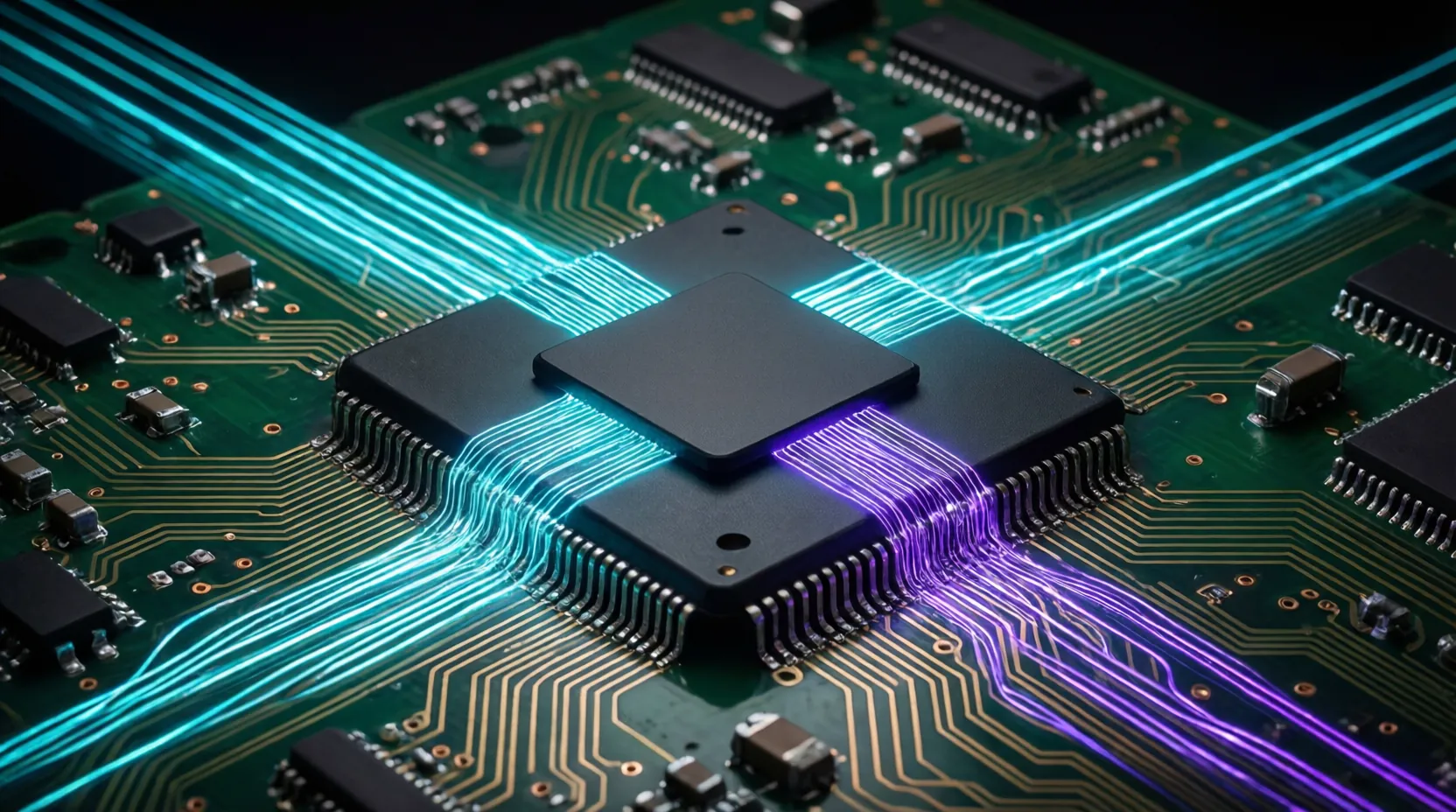
An FPGA consists of hundreds of thousands of small lookup tables, registers, memory blocks and multipliers that are wired into a circuit by configuration. The computation is thus hardware, not a sequence of instructions.
Every event passes through the same stages, and a new one enters on every clock cycle. Sliding windows, sums, ratios and volatility estimators are produced in the stream this way — run time is predictable instead of merely fast on average.
The circuit computes in fixed point. A software twin recomputes the same formulas bit for bit, so any deviation would be visible. What is demonstrated is correctness, not just speed.
For every event we deliver the feature and a checksum — so it remains traceable what the hardware computed from which input.

The research field: streaming analytics in hardware
Online statistics — means, variances, quantiles and correlations that update with every data point — are mathematically well understood. In hardware they become an engineering question: how many bits does a feature need so that rounding errors do not drift over millions of steps, and how do you lay out windows so they fit into fast memory?
The second question is one of data, not hardware: which features carry any signal at all? In markets, machines or networks this differs from stream to stream — hardware makes the computation fast and verifiable, it does not invent predictive power.
Open questions
- Which features of a data stream predict an event before it happens?
- How few bits are enough for hardware and reference to stay identical over long runs?
- How do you combine fixed latency with models that adapt to new data?
If the breakthrough succeeds
Outlook, not a promise: what would become possible once the open questions are answered.
Early warning inside the machine
If reliable precursors of bearing damage were found in vibration or current signals, detection could run directly at the sensor — microseconds after the first sign instead of at the next maintenance interval.
Networks and power supply
An attack on a network or a frequency event in the power grid would be detected at line rate, before software systems have even collected the data.
Risk control at clock speed
In trading, a protective rule would not take effect only after the software stack, but in the same clock cycle in which the market data arrives.
Where we stand
The same evidence as on the overview — every number with its kind.
- Dedicated feature engine on FPGA, checked bit-identical against its software twin
- For market, sensor and telemetry streams
- Raw data, features and checksums per event
Who it is for
- Operators of sensor, telemetry and market data streams
- Industry with real-time monitoring requirements
- Research groups that want to test features reproducibly in hardware
Work on it with us.
We open pilots one by one. Briefly describe what you would like to compute — no payment, no commitment, an honest assessment.
Request a pilot